Key Takeaways from Don’t Kill the Messenger Podcast with Kevin Goetz
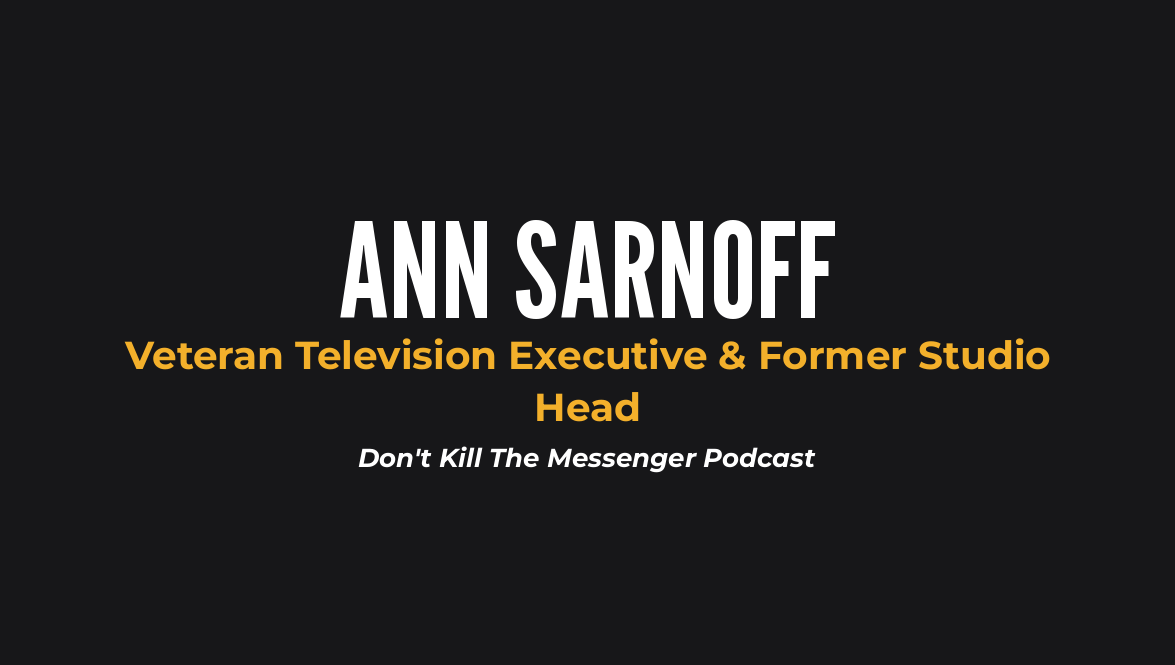
Ann Sarnoff has spent four decades at the center of the entertainment industry’s most significant transformations. She has been at the table during the cable revolution, the peak TV era, the streaming explosion, and the post-pandemic changes. Named one of Forbes’ World’s Most Powerful Women and the first female Chair and CEO of Warner Bros. Entertainment, Sarnoff built her career on a belief in one guiding principle: know your audience. In a recent conversation on Kevin Goetz’s podcast Don’t Kill the Messenger, she shared the philosophy, mentors, and lessons behind her success.
From Wilbraham to Warner Bros.
There was nothing in Ann Sarnoff’s childhood that pointed toward Hollywood. She grew up in a blue-collar, Polish-Catholic neighborhood in Wilbraham, Massachusetts, the youngest child by more than a decade, with parents who worked long hours and came home tired. She filled the gap by doing the housework, cutting the lawn, and competing in three varsity sports. She was elected the team captain of all three.
“The sports, teamwork, competitiveness, and then having to work since I was a young kid — those things shaped me. I tried to do all the housework and the lawn work, little Cinderella-ish. And so I just worked.”
It was a sister living in Maryland who pointed her toward Georgetown, which had just instituted a new admissions policy that would cover her costs. Sarnoff got in, worked her way through on loans and work-study, and graduated as a marketing major with no clear path into the industry she would eventually lead. A boutique strategy consulting firm took a chance on her. A Harvard MBA followed. More consulting followed that. None of it was what she was meant to do long-term, but all of it was building something essential.
“It made me smarter, like super smart. It was almost like an investment banking meets strategy consulting house. So I know how to value a company. I know how P&Ls work and balance sheets. I got a lot of my practical business training at that job.”
The move into media came after the birth of her first child, when she finally allowed herself to pursue the industry she had always wanted.
Standing on Shoulders
Sarnoff has been the only woman in the room more times than she can count. Her approach was never to call it out loudly or make it the centerpiece of every interaction. Instead, she chose a quieter, more strategic form of persistence.
“Why would I do that? I want them to see me as an equal, and I’m gonna more accentuate the things we have in common than the things we have different.”
She is quick to credit the women who made her own ascent possible – Sherry Lansing, Kay Graham, Shelly Lazarus, and Geri Laybourne at Nickelodeon, whose mentorship Sarnoff describes as foundational. And she is equally direct about what still needs to change, referencing the DEI work done at MTV Networks under Tom Freston at a time when neither the law nor the culture demanded it.
“We did it because it was the right thing to do, but also because we weren’t representing the audiences. We’re sitting around the executive table, and we didn’t look like the audience. And in the media business, people tend to program to themselves. If you’re not diverse in who’s making those decisions, you will fail.”
The Nickelodeon Years and the Art of Knowing Kids
Sarnoff’s time at Nickelodeon is where her philosophy of audience-first programming was forged. As head of strategy and later research, she oversaw a department running roughly 200 focus groups a year. The purpose of these focus groups was not to ask kids whether they liked a show, but to understand what made them tick, what scared them, what they wanted from their friendships, their parents, and their world.
“Cable started with the customer. That is the key. It went to what people love. You love music, we’re gonna give you MTV. You like comedy? Comedy Central. The advertisers got a much more efficient route to market. And Nickelodeon got so big because we were true to the audience. That was the special sauce.”
That strategy produced some of the most enduring children’s programming ever made. When a toy executive told Sarnoff that the Rugrats babies were ugly, she pushed back immediately. “That’s because you’re looking at it through your adult lens. If you’re a kid, you look at Tommy Pickles as a hero.”
The Blue’s Clues story is another example of what happens when you truly let go of adult assumptions. After an early focus group where two-to-five-year-olds ran up and touched the screen, thinking the host was speaking directly to them, the team knew they had something extraordinary. Out of necessity, they began airing the same episode five days in a row — something unheard of on television — and discovered that ratings rose every day through Thursday.
“If you’re thinking like an adult, none of these things would have happened. Knowing your audience — that’s where the genius came from.”
Breaking the Barrier at Warner Bros.
By the time John Stankey called in the spring of 2019, Sarnoff had spent decades building toward a moment she couldn’t have planned. Her daughter had just matched to her first-choice residency at UCLA. The timing felt like more than a coincidence. She arrived at Warner Bros. in August 2019 and walked into Jack Warner’s office, her new workspace. On the wall was a photograph of every person who had ever held her job. All of them were men. Dating back to 1923.
“Probably one of the most proud, iconic remembrances of my time there is my picture on that wall with all the men from 1923 on.”
There was also something waiting in the office that she hadn’t expected. The Warner Archive had found, among the papers of her father-in-law, William Sarnoff, who had purchased DC Comics decades earlier, the original letter approving Christopher Reeve as Superman for the Richard Donner film. It was framed and hanging on the wall. Her first months were defined by building trust. She clarified accountabilities, instituted regular meetings with her direct reports, and drew a clear line around confidentiality after a sensitive conversation appeared in the Hollywood Reporter.
“We all got paid good money. We all need to focus our energy on making the company successful. The company comes first.”
Joker launched weeks after she arrived, won the Golden Lion at Venice, and became one of the biggest films in Warner Bros. history. Nobody had predicted the scale of it. Then COVID arrived, the streaming wars accelerated, and Sarnoff found herself steering an iconic institution through a period of transformation that the industry is still processing.
The Reckoning and What Comes Next
Sarnoff traces the current period of consolidation and correction directly back to the dynamics that took hold during the streaming era. Every platform needed content. COVID sent audiences home and further amplified demand. Production scaled to meet a moment that, in retrospect, was unsustainable.
“All of that led to an accumulation of content that what we’ve been suffering with since COVID started abating was just this escalation of production that wasn’t necessarily trued up to where the demand was. It was circumstantially supply-side things that propelled the increases.”
She sees 2024 as the reckoning and the current moment as one of genuine stabilization. And she is cautiously optimistic about what a reset makes possible.
“I think kind of the creative and the commercial are coming together more cohesively now. There’s been a lot of disjointedness in those two areas. I just hope that as we reset and start to grow again, that the creativity is as broad as possible.”
Her worry is not that the industry will fail to recover. It is that a recovery built only on superheroes, action, and horror will leave too much on the table. The audiences are there for original stories. The demand is there, and someone just has to be willing to green-light them.
Theaters as the Third Space
Drawing on her board role at Regal Cineworld, Sarnoff makes a case for theatrical exhibition that goes well beyond the movies themselves. She points to overcapacity that has existed since at least 2001, ticket revenue that masked flat attendance for years, and a real estate footprint that is currently largely unused from Sunday through Thursday.
The solution, in her view, is not to double down on the same model. It is to reimagine what a theater is for.
“Why wouldn’t you go to a movie theater and have it treat the experience more like a party? I think there should be a quiet car and a noisy car version, because if you’re in Wicked and you want to sing at the top of your lungs, you should be able to do that.”
She envisions theaters expanding into live sports, gaming, comedy, the creator economy, first and last episodes of major franchise series, and events where audiences can dress up and celebrate the things they love. She points to the finale of Stranger Things as proof.
“People want to gather in third spaces. You have your home, your work, and then you want somewhere else. Theaters are a perfect third space. The only limit is our imagination of what we can do in those buildings.”
Her message to exhibitors is the same one she has carried through every role she has ever held. Start with the customer. Find out what they want. Then build it.
“Knowing your audience — that’s where the genius came from.”
The full conversation between Ann Sarnoff and Kevin Goetz is available now.
For more information about Kevin Goetz:
Want to go deeper on audience insight and why it matters in today’s movie business?
Explore Audience360—Kevin Goetz’s hub for books, conversations, and tools that show how audience research shapes what gets made, marketed, and remembered.
Books
- Audience•ology – A definitive, behind-the-scenes look at how studios test films, interpret audience feedback, and make high-stakes creative decisions before release.
- How to Score in Hollywood – A practical guide to building commercially successful movies, showing how audience insight drives development, marketing, and profitability from script to screen.
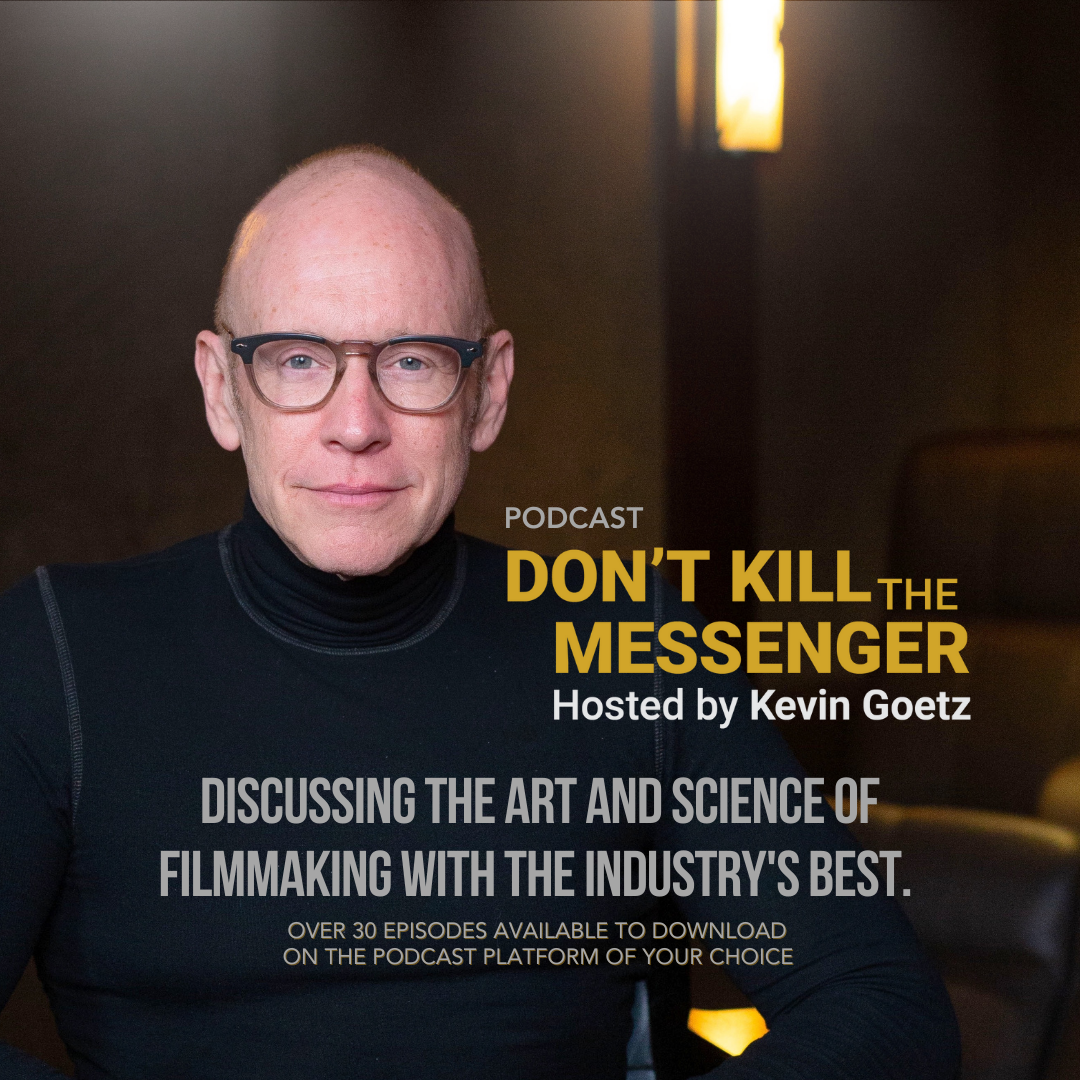
Podcast: Don’t Kill the Messenger
Candid conversations with filmmakers, executives, and creatives about storytelling, testing, and the realities of making movies in today’s marketplace.
Prepared educational materials—including case studies, frameworks, and real-world examples—designed for film students, educators, and emerging filmmakers to understand how audience insight fits into the moviemaking process.
Follow Kevin:
Instagram, Facebook, X, TikTok, YouTube, Substack, LinkedIn