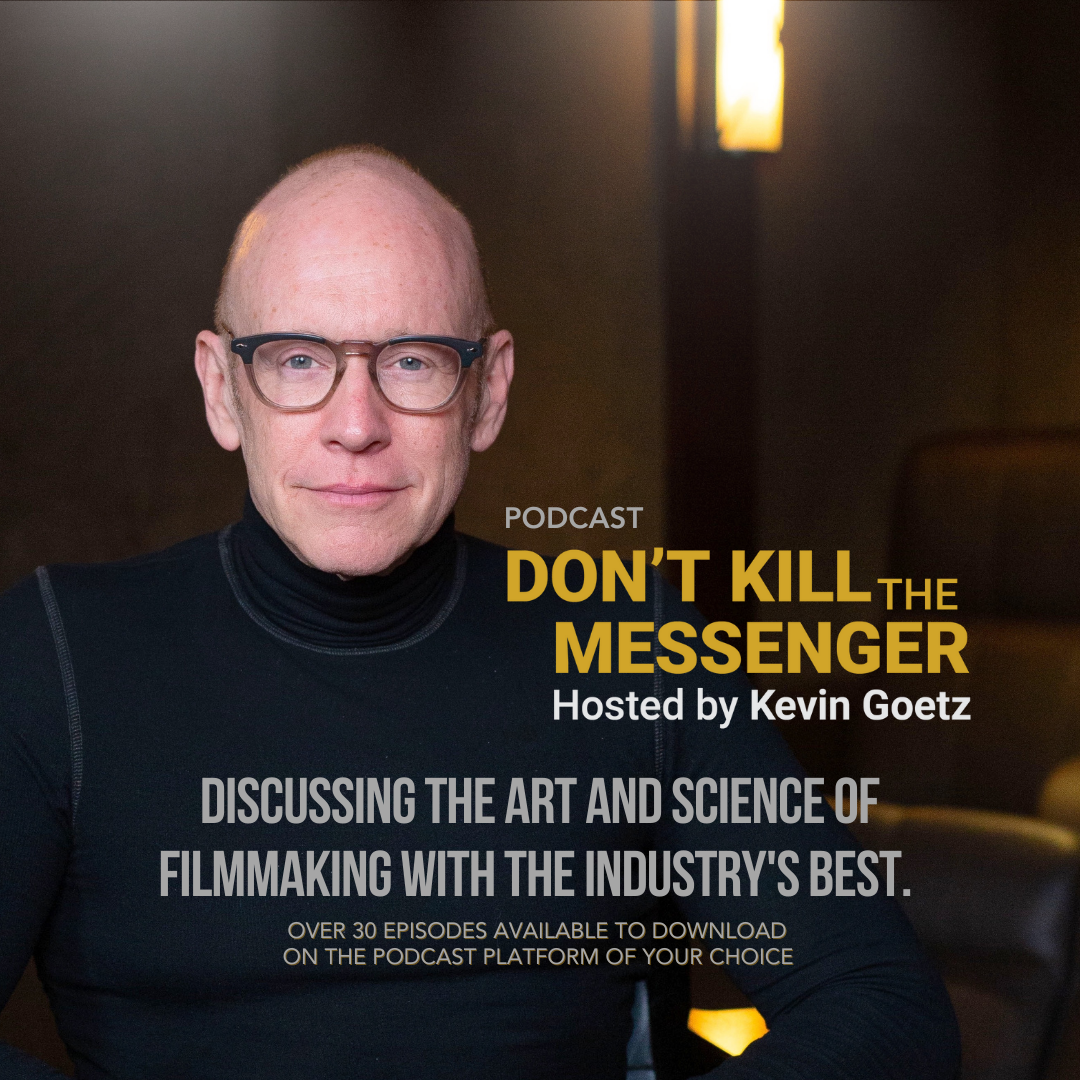
Key Takeaways from Don’t Kill the Messenger Podcast with Kevin Goetz
In the latest episode of Don’t Kill the Messenger, host Kevin Goetz sits down with Academy Award-winning producer Charles “Chuck” Roven, the co-founder of Atlas Entertainment, one of Hollywood’s most enduring and successful production companies. Over four decades, Chuck has built a producing career defined by creative ambition and commercial scale, including five of the 100 top-grossing films of all time. From his early struggles to winning the Academy Award for Oppenheimer, their conversation reveals how creative dealmaking, business acumen learned from his father, and an unwavering commitment to audiences built one of the most successful producing careers in modern Hollywood history.
The Horizontal Learning Principle
Chuck’s foundation for producing began in an unexpected place: his father’s real estate business in post-war Los Angeles. His father, a Jewish immigrant who escaped Czechoslovakia in 1948, started with a liquor store on Wilshire and La Brea before discovering the opportunities in California real estate. He built developments called “Cinderella Homes” in the San Fernando Valley, buying ranches and subdividing them into single-family homes. While getting zoning approvals, he would hire cowboys to run cattle on the property, and young Chuck would spend weekends riding horses and working with the cattle.
This upbringing taught Chuck something that would define his producing career. Business isn’t vertical, it’s horizontal:
“That’s why I believe that a lot of people talk about vertical. I believe in horizontal because learning about this business, any business, the dynamics of it will help you learn about things, particularly in the movie business or the content creation business. Because you have departments and you’re dealing with construction, you’re dealing with finance, you’re dealing with negotiating deals with studios, which is real estate.”
This philosophy gave Chuck an edge that most creative producers lack. He understood financing structures, construction logistics, and negotiation strategies because he’d absorbed them from childhood. When he later pioneered innovative international co-financing deals, he drew on lessons learned by watching his father leverage government loans to build a successful real estate business.
Between high school and college, Chuck took a year off to surf in Hawaii. He loaded roofing trucks at night to fund his days on the water. When a buddy told him about a TV series called Hawaii Five-0 looking to pay surfers, Chuck couldn’t believe it…they were going to pay him to surf? That was his entry into the entertainment business.
The Student Film That Changed Everything
Despite his father’s initial resistance to a film career, Chuck transferred to USC film school. His cousin taught a class called “director acts” where directors learned to work with actors. Chuck audited the class before making any of his own movies. One day, when a director’s partner didn’t show up, they asked Chuck to do a scene. He was offered a role in a student film that did very well, which helped him get into film school.
The turning point came with his third student film, which starred his best friend and his sister:
I showed it to my dad, and he had tears in his eyes when it was over, and he said, ‘I get it now.’
That moment of recognition from his father gave Chuck permission to pursue the career that would eventually lead to an Oscar.
Dawn Steel and the Rise of a Hollywood Power Couple
Chuck’s first wife was Dawn Steel, who became one of Hollywood’s most powerful executives as president of production at Paramount Pictures. Her entry into entertainment is the stuff of legend. She started as the secretary for Larry Flynt. When the company had no consumer products division, Dawn pitched an idea:
“She came to Larry Flynt and said, ‘I have an idea. I think we should open up a consumer products division, which I would like to run. And I think the first idea would be to make the cock sock for the man who has everything.’ And it sold out. So she went merch. That was her first foray.”
When Flynt refused to give her a piece of the action, Dawn left and started her own company called “Oh Dawn.” Without securing rights, she created Gucci toilet paper. It sold out before Gucci’s lawyers shut it down. But the audacity caught Paramount’s attention, and they hired her to run their consumer products division. She was so good at merchandising that they moved her into creative development. Her first production executive movie was Flashdance. Within three to four years, she was president of production.
Chuck met Dawn at a premiere right after she’d been promoted. They had a fast courtship and got married. But their early marriage coincided with Chuck’s career struggles. After his acclaimed first film Heart Like a Wheel, his second movie, Made in USA, had a disastrous test screening at Paramount:
It was a 300-seat theater. And by the time the movie was over, there were about 50 people left. And she was not happy. She thought I had embarrassed her. She didn’t go, ‘Honey, don’t worry about it.’ That did not come outta her mouth. No, it came outta her mouth. ‘Listen, how dare you come to my lot and exhibit that.’ But we got through it.
Chuck describes this as probably his lowest point. Having a wife at the pinnacle of her career while he struggled with failure tested them both. Dawn went on maternity leave when their daughter Rebecca was born, and studio chief Ned Tanen used it as an excuse to push her out. Columbia came calling, and Dawn’s career continued to rise. But the experience shaped Chuck’s understanding of resilience and perseverance in Hollywood.
The 90-Day Escrow Deal
One of Chuck’s most brilliant early deals demonstrates his creative approach to rights acquisition. He wanted to develop Dick Tracy, but couldn’t afford a traditional option. Instead, he negotiated a 90-day escrow deal:
“I made a 90-day escrow deal. They put the rights to Dick Tracy in escrow for 90 days, telling both the Chicago Tribune and Chester Gould’s lawyer that I needed 90 days to check, because Dick Tracy was so old I needed to check the title for 90 days. So in those 90 days, I wrote a script with two other guys, sold it to Ned.”
12 Monkeys and the Art of International Co-Financing
Chuck’s breakthrough as a producer came with 12 Monkeys, based on Chris Marker’s experimental short film La Jetée. He flew to Paris to meet with the filmmaker and secured the rights. He hired screenwriters David and Janet Peoples, who delivered the script. But finding the right director proved challenging. Dawn had a terrible experience with Terry Gilliam on Baron Munchausen at Paramount. When Chuck sent Gilliam the script, and he loved it, Chuck had to deliver some news:
“I said, ‘Well, you need to know something.’ And he said, ‘What?’ I said, ‘My wife is Dawn Steel.’ And I don’t know how well you know Terry, but he’s got this cackle of a laugh. And so he says, ‘You know, Chuck, this is just another proof that there is no bridge you could burn in Hollywood.’”
Dawn was furious, but the movie moved forward. The bigger challenge was financing. Universal didn’t trust Gilliam with a $32 million budget. So Chuck pioneered a structure that became a template for independent financing:
“I went to what was then Polygram and the BBC for the UK. And then I went to TeleMunchen, which was German. And I went to Toshoku, which was Japan. I said, ‘You’re not just going to get your territory. You’re gonna get a piece of what Universal’s gonna distribute in the other territory.’”
Universal put in half the budget. Each international partner got their territory plus a piece of Universal’s worldwide distribution. Each territory covered its own marketing. The structure was brilliant because it spread risk while giving partners upside beyond their own markets. The movie cost $30 million and grossed $180 million worldwide. Chuck and his partners are still making money from the receivables.
The Producer Who Gets Invited to the Party
After 12 Monkeys, Chuck’s success with City of Angels established him at Warner Bros. He also went into the music business with Bob Cavallo, forming Atlas Third Rail. The City of Angels soundtrack became the biggest record of the year, breaking the Goo Goo Dolls and earning three Grammys, including one for Alanis Morissette’s “Uninvited.”
These successes led to something rare in Hollywood. Chuck started getting calls to join other producers’ projects. Jeff Robinov called him to produce Three Kings with David O. Russell at Warner Bros. The same executive called him for Batman Begins. Kevin Goetz reflects on what this means:
“For a producer in this town, to be invited to be a producer on something is probably one of the rarest, most affirming things that can happen. Because producers generate material. They’re a quote-unquote dime a dozen, but there ain’t a lot of Chuck Rovens.”
Chuck’s response reveals both humility and pride:
I’m not gonna deny that it doesn’t make me happy. It makes me very happy. And I’ve been blessed to work not only with incredibly talented guys like David Russell and obviously I think one of the all-time greats, Chris and Emma.
Christopher Nolan and the Batman Partnership
The Batman Begins partnership came through Chuck’s agent Dan Aloni, who also represented Christopher Nolan. Chuck had just produced Scooby-Doo, which was a nine-digit hit. Nolan’s biggest movie at that point was Insomnia at $30 million. Warner Bros. felt Nolan and producing partner Emma Thomas needed an experienced studio producer. Chuck had proven himself with both commercial hits and critically acclaimed films.
Chuck describes why Nolan became one of the few directors who can be a brand name:
“He’s just that brilliant. And he knows every aspect of making movies and writing scripts and he cares about every aspect. And also has a great partner in Emma who’s a great producer as well. Because she engages. And they don’t always agree, which is great. And by the way, it’s a subjective business, isn’t it? You can’t always agree.”
That last observation is crucial. Chuck values creative partnerships with healthy disagreement. Emma Thomas isn’t just supporting Nolan’s vision, she’s challenging it and shaping it. That dynamic produces better films.
Bringing Oppenheimer to Christopher Nolan
The Oppenheimer story begins with betrayal. During COVID, Warner Bros. executive Jason Kilar made a decision that destroyed the studio’s 22-year relationship with Nolan and Thomas. When Tenet was delayed by the pandemic, the question became whether to release it theatrically or simultaneously on streaming. Chuck was producing Wonder Woman 1984 at the time:
“My big question was, I need to understand if we’re gonna do simultaneous release, is it gonna be the whole slate or is it gonna be one movie depending on what the movie is? And in that meeting, Jason said, ‘No, I would never do simultaneous release on our tent poles. We’re going to deal with it one movie at a time.’ And I said, ‘Okay, fine. I’m in.’ Two weeks later he announced the whole slate as simultaneous release.”
Chuck felt betrayed. Nolan and Thomas felt even more so. The relationship with Warner Bros., which had produced the Dark Knight trilogy, Inception, Dunkirk, and other masterpieces, was over. That’s when Chuck made his move:
“Did you get a call to get involved in Oppenheimer? No, I brought Oppenheimer to Chris.”
Chuck recognized that Nolan needed a new home and a project worthy of his talents. He brought the Oppenheimer material to Nolan, and Universal embraced the partnership. The result was a film that earned 13 Oscar nominations and won 7, including Best Picture.
On Oscar night, Chuck approached the evening differently than he had for American Hustle, which received 11 nominations but won nothing:
“The last time I was nominated for Best Picture, American Hustle got 11 nominations and we didn’t get one. So you just went to have a good time. I said I don’t want to jinx anything. Who were you with? I was with my wife, Stephanie Haymes Roven. And I called her my secret weapon.”
When they won, it was Chuck’s first Oscar after decades of producing some of Hollywood’s biggest films. The validation meant everything.
The Value of Test Screenings
Throughout his career, Chuck has been a fierce advocate for test screenings with recruited audiences, even when working with directors who resist the process. Christopher Nolan doesn’t test his movies with recruited audiences, preferring friends and family screenings. But Chuck believes in both:
“I like to do a friends and family screening first and then go to an audience. But it’s invaluable to have an audience tell you what they’re thinking, and you learn a tremendous amount from it.”
Kevin breaks down why test scores matter more than most filmmakers realize:
“A definite recommend score that may be 20 points above the average or norm could be tens of millions of dollars. Audiences often can’t tell you how to fix it. They just tell you what’s not working. But you, as the creative producer, and the director need to figure that out.”
This philosophy was put to the test with Chuck’s latest film, Mercy, a thriller about an AI judge directed by Timur Bekmambetov. The film uses Bekmambetov’s “Screen Life” technique, showing everything through screens, cameras, and digital interfaces. Chuck tested the film multiple times, making incremental improvements each time. The breakthrough came when they listened to what the audience was really saying:
“First of all, we listened to the audience. The second thing that we finally did was we cut the denouement. We didn’t think we needed it. The coda, yeah. We didn’t think we needed it. It wasn’t buying us anything. It actually was raising more questions than it answered.”
The film ended at its most powerful moment instead of continuing past it. The audience had been telling them this all along, but it took multiple screenings to hear it clearly. Chuck’s partnership with visual effects company DNeg and its head Namit Malhotra led to another innovation. Malhotra suggested converting the film to 3D:
“We actually gave his company all of the visual effects, and at the end of it, he said, ‘You should seriously think about doing this in 3D.’ And I love that idea. And he put his money where his mouth was. He said, ‘I’ll give you test footage of the 3D that I’m talking about, and if you guys want to do it after that, I’ll make a financial deal with MGM and get a piece of that 3D business.’”
The 3D glasses made the Screen Life concept even more immersive, pulling audiences deeper into the unsettling world of AI surveillance. It was the kind of creative partnership that only happens when producers value collaboration and innovation.
The Producer Who Does Everything
Kevin Goetz describes Chuck as the consummate producer, someone involved in every stage from development through marketing and release. Chuck is on set every day, deeply engaged in post-production, and active in shaping how films reach audiences. This comprehensive approach is increasingly rare. Many producers focus on dealmaking or attach themselves to projects without doing the daily work. Chuck represents an older model of producing that requires relentless commitment.
That commitment has generated billions of dollars in worldwide box office and critical acclaim across four decades. Chuck has produced five of the 100 top-grossing films of all time. His body of work includes the Dark Knight trilogy, American Hustle, Three Kings, Suicide Squad, and now Oppenheimer. He’s currently producing Ramayana, one of the biggest films ever to come out of India, attempting to create the first non-American blockbuster that works worldwide.
Chuck’s producing philosophy combines the business lessons learned from his father with creative instinct and respect for audiences. He understands that great films require smart financing, strong creative partnerships, and the humility to listen when test audiences tell you something isn’t working. He knows that in Hollywood, there really is no bridge you can burn, so maintaining relationships matters as much as making great movies.
From the kid who surfed in Hawaii and rode horses on his father’s ranches to the producer who brought Oppenheimer to Christopher Nolan and won an Oscar, Chuck Roven’s journey demonstrates that hunger, passion, and smart dealmaking can sustain a legendary career across generations of Hollywood transformation.
The full conversation between Chuck Roven and Kevin Goetz on Don’t Kill the Messenger offers an even deeper dive into the producer’s creative process, revealing how one of Hollywood’s most successful producers built an empire on horizontal learning and unwavering tenacity.
For more information about Kevin Goetz:
Want to go deeper on audience insight and why it matters in today’s movie business?
Explore Audience360—Kevin Goetz’s hub for books, conversations, and tools that show how audience research shapes what gets made, marketed, and remembered.
Books
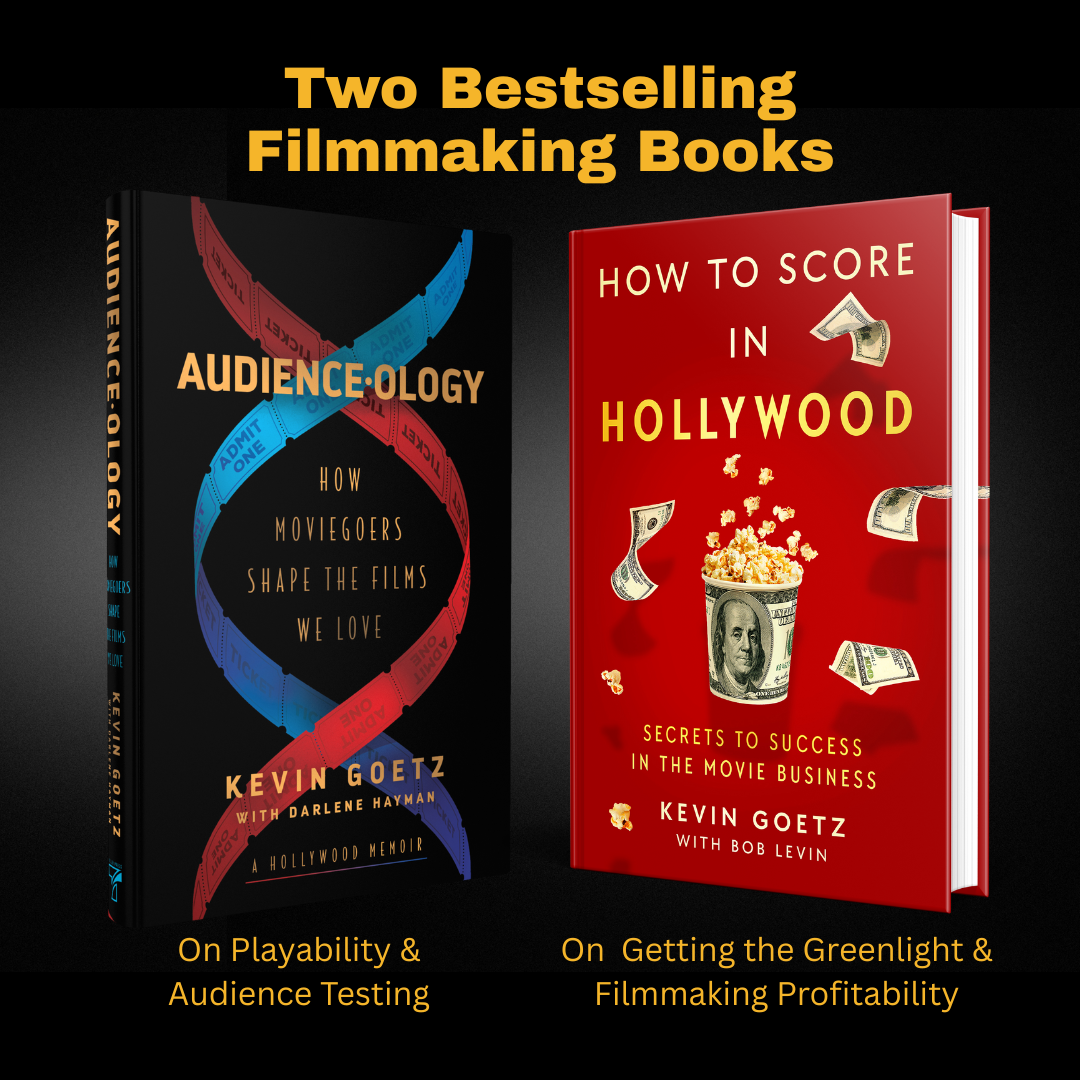
- Audience•ology – A definitive, behind-the-scenes look at how studios test films, interpret audience feedback, and make high-stakes creative decisions before release.
- How to Score in Hollywood – A practical guide to building commercially successful movies, showing how audience insight drives development, marketing, and profitability from script to screen.
Podcast: Don’t Kill the Messenger
Candid conversations with filmmakers, executives, and creatives about storytelling, testing, and the realities of making movies in today’s marketplace.
Prepared educational materials—including case studies, frameworks, and real-world examples—designed for film students, educators, and emerging filmmakers to understand how audience insight fits into the moviemaking process.
Follow Kevin:
Instagram, Facebook, X, TikTok, YouTube, Substack, LinkedIn