Key Takeaways from Don’t Kill the Messenger Podcast with Kevin Goetz
In this episode of Don’t Kill the Messenger, host Kevin Goetz sits down with his dear friend Robert Wagner, known to everyone as RJ, on the eve of his 96th birthday. One of only a handful of people still living who was part of the original Hollywood studio system, Wagner reflects on eight decades in film and television, the extraordinary legends he knew and worked alongside, and the family and friendships that sustained him.
A Fairway Full of Stars
Robert Wagner grew up in Michigan. His father was in the automobile business and eventually moved the family west to California. That move, Wagner says, changed everything.
“I just loved the movies. I wanted to be an actor, and I’ve been very fortunate, Kevin, because what I wanted to do and be, it worked out for me. I was just very, very fortunate.”
The first film Wagner recalls seeing was Marie Antoinette. Not long after, he found himself attending school with Irving Thalberg Jr., which meant weekend visits to the Thalberg beach house on Santa Monica Beach, where Norma Shearer, the actress who had played Marie Antoinette, was warm and kind to a starstruck young boy who couldn’t quite believe where he’d landed.
The proximity to Hollywood royalty only deepened when Wagner took a job caddying at the Bel Air Country Club. All the older caddies had gone to war, and the boys stepped in. One afternoon, Wagner looked up and saw Clark Gable, Cary Grant, Fred Astaire, and Randolph Scott walking down the fairway together.
“I see the four of them, and I don’t know, Kevin. It’s like it’s in the stars someplace. I mean, look what happened to me with those four men. I became very close with Cary Grant. Fred Astaire, I played his son in It Takes a Thief. And Gable set me up to go to MGM. And Randolph Scott, he was just a wonderful man to me.”
Kevin calls it divine intervention. Wagner agrees.
The Studio System and Getting Signed
Wagner auditioned at every major studio before 20th Century Fox said yes. The credit goes largely to Helena Sorrell, his acting coach there, who pushed Darryl Zanuck to look at Wagner’s screen test a second time.
“She said, ‘Just take a look at it again and watch this.’ And he did, and he said, ‘Oh, Helena, if you think he’s right, then we’ll take him.’ So I was signed for $75 a week. 55 take home. God. But I was in the movies, and it was great.”
Fox put him through the full contract player treatment: acting classes, dancing classes, fan magazine features, tours, and small parts in big movies. Wagner also became the studio’s go-to screen test partner for incoming actresses, which is how he first met Marilyn Monroe.
“I did Marilyn Monroe’s two tests and that’s when I first met her. She was, by the way, a wonderful person.”
His real breakthrough came when Zanuck cast him as a shell-shocked soldier in With a Song in My Heart alongside Susan Hayward. Wagner had no lines.
“I said, ‘Mr. Zanuck, I don’t have any lines.’ And he said, ‘Well, I think people will come out of the theater, and they’ll say, who was that guy?’ And that’s what they did. And that’s what really set me off.”
Wagner speaks about the major figures in his life not as names to drop, but as people he loved and who genuinely helped him. Spencer Tracy is near the top of that list. After working together on Broken Lance, directed by Eddie Dmytryk, Tracy personally requested Wagner for The Mountain and gave him co-star billing above the title, a gesture that set him apart from the crowded field of attractive young contract actors competing for the same roles.
“He lifted me out of that. And I’m forever grateful to him for that.”
Wagner served as a pallbearer at Tracy’s funeral. His daughter Katie is named after Katharine Hepburn.
Fred Astaire is another figure whose presence in Wagner’s life has an almost fairy-tale quality. They met because Astaire’s son attended the same boarding school as Wagner, and Astaire would pick him up on weekends without Wagner fully registering who this extraordinarily kind man was. Decades later, filming It Takes a Thief in Rome, Wagner watched Astaire spontaneously dance through a grand ballroom for the crew.
“The crew was going, ‘Fred, Fred, Fred, Fred.’ And he started to dance, and he danced around the ballroom, kicked a couple of columns, you know, did the whole thing. Oh, it was fantastic. It was unbelievable.”
Wagner later cast Astaire as his father on that very show.
When Wagner was preparing to play a suave thief for It Takes a Thief, he went to Cary Grant for advice. Grant’s answer was simple: “He said, ‘Well, just do you.’ And I said, ‘Well, what do you mean?’ He said, ‘Just play you. Don’t try to do anybody else.’”
John Ford and a Lesson in Power
Not every experience on set was warm. Wagner worked with John Ford, whom he acknowledges as a great director, but who had a habit of picking someone to torment on every picture. On that film, it was Wagner.
“I would have won the Academy Award if they put the camera on me when he knocked me down. I was so surprised. Here I was in this movie, and he was the number one director. And suddenly I’m on the ground, and he’s knocked me down.”
The incident occurred because Wagner glanced toward the music, following a stage direction in the script. Ford stopped the scene and hit him. Later, when Ford picked up a rock to throw at Wagner in a trench, John Wayne had to physically hold Wagner back.
“He says, ‘Just take it easy, kid. Take it easy.’”
Jimmy Cagney, whom Wagner had befriended before ever working with him by jogging his horses, was also on set and looked out for him throughout.
The Move to Television and Austin Powers
When the studio system collapsed and Fox dropped its contract players, Wagner took it in stride. Single at the time, he moved to Rome, where he worked with Sophia Loren and Vittorio De Sica and appeared in The Pink Panther, which he calls his all-time favorite film.
“Oh, we all had such a great time. Sellers — see him create that character, and he and Blake together create Clouseau.”
The pivot to television came at the urging of Lew Wasserman, who called Wagner into his office and made a case that was hard to argue with.
“He said, ‘You know, I want you to be in television. I want you to be in this TV Guide every week. I think this is your medium. I think this is right for you.’”
Wagner was skeptical. Television was considered beneath film stars at the time. But after meeting writer Roland Kibbee and reading the It Takes a Thief script, he came around. The show became a hit, and Wagner arguably became more famous on television than he had been in movies.
Hart to Hart came later, and Wagner fought hard to cast Stephanie Powers as Jennifer Hart over significant network resistance. They had doubts because of a previous series she’d done. Wagner didn’t waver.
“I wanted her to be Jennifer Hart, and so did Tom Mankiewicz. I had worked with her before when I did Thief, and I always liked her, and I thought the chemistry with us would be terrific. I just felt it.”
He also made a point of casting Lionel Stander, who had been blacklisted during the McCarthy era, as the show’s beloved Max. Wagner calls the Hollywood blacklist one of the industry’s biggest stains. Stander became one of his dearest friends.
And then, decades after his television peak, a whole new generation discovered Wagner in an entirely different way. His turn as the villainous Number Two in the Austin Powers franchise introduced him to audiences who may never have seen a single frame of It Takes a Thief or Hart to Hart – proof that a career built on range and instinct has a way of finding new life in unexpected places.
Bette Davis and Barbara Stanwyck
Wagner speaks with particular warmth about the women in his career. He had a three-year relationship with Barbara Stanwyck, whom he describes simply as “a marvelous lady and a great actress.” He’s characteristically gracious about it.
Bette Davis praised his work on It Takes a Thief in the New York Times at a time when she wasn’t working. Wagner called her.
“I said, ‘Bette, it was wonderful what you said about me and wound up in the Times. So would you like to do the show?’ She said, ‘Yes.’ So we wrote a character for her, she came out to Los Angeles, and she did this character for us, and she was great. And from that, she rolled into doing the shows on stage across the country.”
Family, Loss, and Jill St. John
The episode’s most moving passages come when Wagner reflects on the personal losses and the people who brought him back.
“I thought I was finished when I lost Natalie. And I came back from that through my children and through Jill and through you and Neil, and it makes a big difference.”
After Natalie Wood’s death, Wagner gathered all the children together, including his daughters Natasha and Courtney, and Stanley Donen’s sons Josh and Peter, creating what Kevin calls a real-life Brady Bunch held together by love.
His wife, Jill St. John, whom he first met when she was 16 and under contract at Fox, is described with quiet reverence.
“I wanna tell you I wouldn’t be here if it wasn’t for her. Because she really held me up when she came into my life.”
When Kevin asks what Wagner wants people to say about him at this point in his life, the answer is modest and completely in character.
“I’ve been so fortunate to be able to do what you wanna do in life. And it’s been good to me. I’ve been successful in it, and I’m just a very lucky and fortunate man.”
Few careers in Hollywood history span as many eras, genres, or legends as Robert Wagner’s, and fewer still have been lived with such grace and longevity.
The full conversation between Robert Wagner and Kevin Goetz on Don’t Kill the Messenger goes even deeper into the stories behind the stories, from the inner workings of the Fox contract system to the personal relationships that shaped one of Hollywood’s most enduring careers.
For more information about Kevin Goetz:
Want to go deeper on audience insight and why it matters in today’s movie business?
Explore Audience360—Kevin Goetz’s hub for books, conversations, and tools that show how audience research shapes what gets made, marketed, and remembered.
Books
- Audience•ology – A definitive, behind-the-scenes look at how studios test films, interpret audience feedback, and make high-stakes creative decisions before release.
- How to Score in Hollywood – A practical guide to building commercially successful movies, showing how audience insight drives development, marketing, and profitability from script to screen.
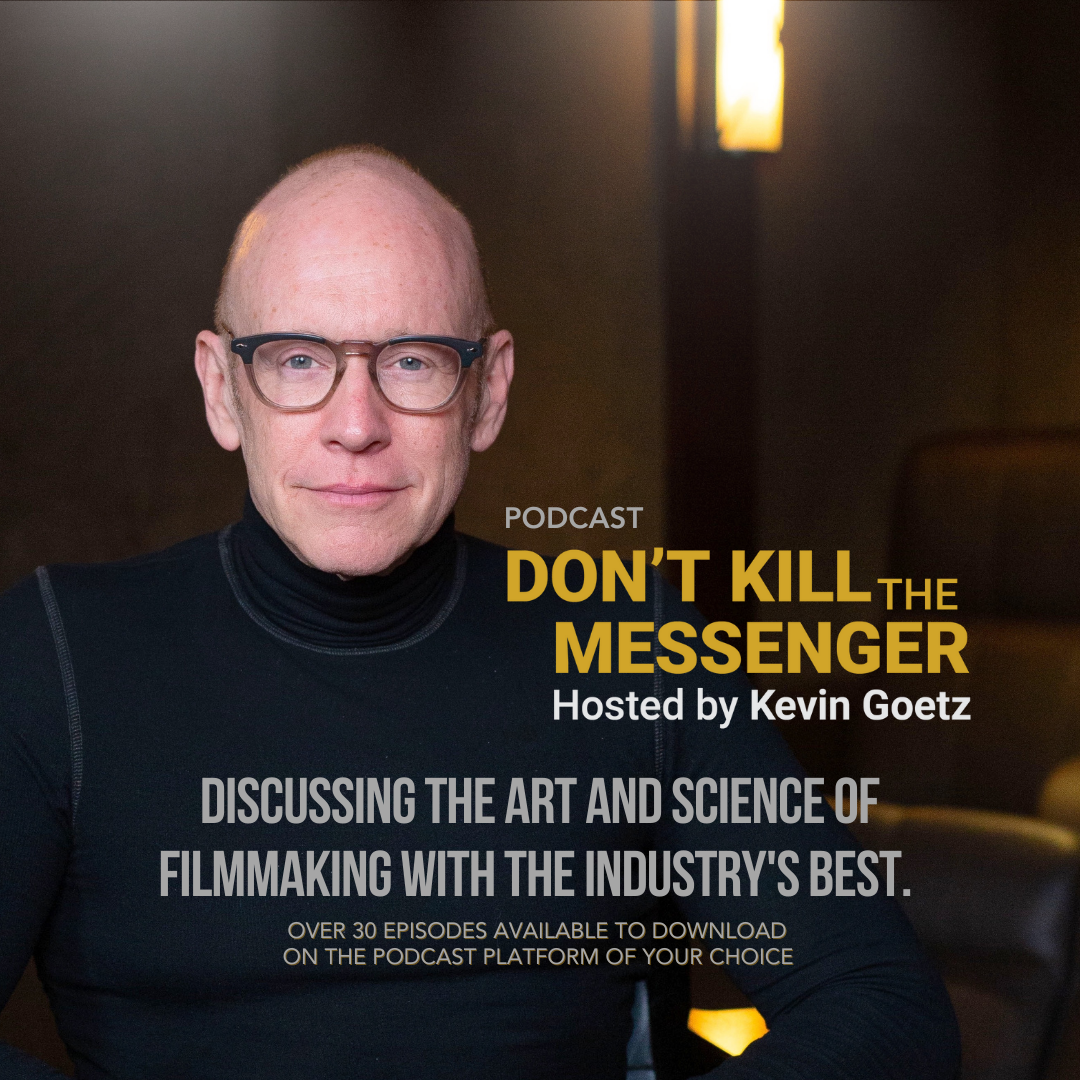
Podcast: Don’t Kill the Messenger
Candid conversations with filmmakers, executives, and creatives about storytelling, testing, and the realities of making movies in today’s marketplace.
Prepared educational materials—including case studies, frameworks, and real-world examples—designed for film students, educators, and emerging filmmakers to understand how audience insight fits into the moviemaking process.
Follow Kevin:
Instagram, Facebook, X, TikTok, YouTube, Substack, LinkedIn